
Hatay’s capital, Antakya (ancient Antioch), has been a crossroads for a very long time. It was the eastern capital of the Roman Empire and the first city outside Jerusalem where Christianity spread. The town was built in a valley at the start of the Amik Plain, between the Amanos Mountains and the Habib Neccar Mountains. That mix of cultures ended up on the table, and Antakya cooking is clearly influenced by Arab cuisine, with a heavy emphasis on meat and bulgur, much like the cooking of Adana, Mersin and İskenderun along the eastern Mediterranean.
The dishes to know before you sit down
Some of the better-known dishes on a Hatay menu are easy to love at first bite. Kekik salatası is a thyme salad seasoned with zahter, a local spice blend. Humus is the chickpea-and-tahini purée you may know, served here with butter and pistachios. Patlıcan salatası is an eggplant salad eaten with garlicky yoghurt. Çiğ köfte and hot künefe round out the usual introductions.
Then come the dishes that really mark you as someone who ate in Hatay and not just passed through.
Oruk
This is Antakya’s take on içli köfte, the stuffed bulgur-and-meat croquette. It is not boiled or deep-fried here: it is baked with olive oil.
Muhammara
A dip made from pepper paste, toasted bread, crushed walnuts, tahini and pomegranate sour. It is a staple of çilingir sofraları, the drinking tables where meze is the whole point, and it is also one of the cornerstones of the local meze spread.
Ekşi aşı çorbası
A tomato-based soup with tiny stuffed meatballs, each filled with butter or oil. It is sour, spiced and intense, and it is one of the dishes most often cooked for the evening meal.
Semirsek böreği
A savoury pastry made with baklava-style thin dough, filled with ground meat, onion, parsley and spices.
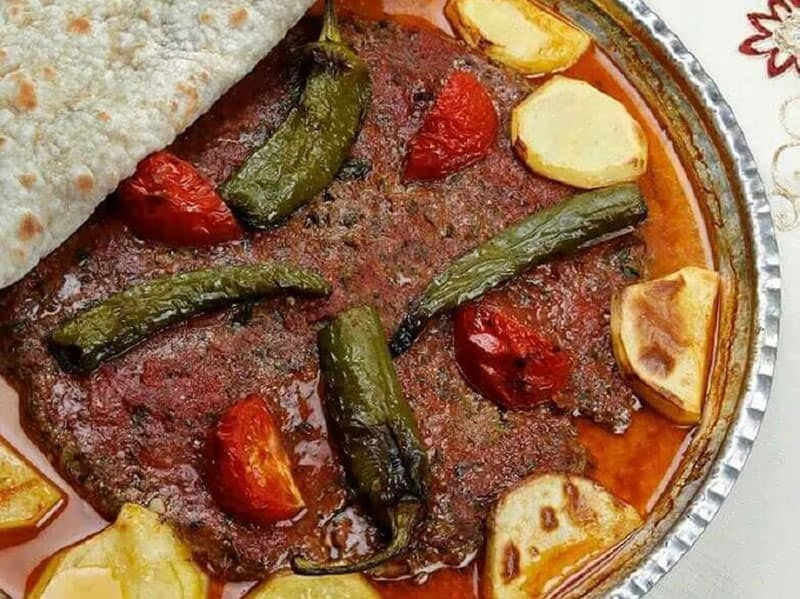
Tepsi kebabı
Named after the way it is cooked, this kebab combines minced meat, tomatoes, peppers and onion. Restaurants in Hatay prepare it in large trays called sini, so you will also hear it called sini kebabı.
Etli aşur
Boiled wheat, chickpeas and meat are pounded together until the mixture turns paste-like. The flavour sits somewhere between içli köfte and lentil köfte.
Kaytaz böreği
Think of something between Hatay’s pepper bread and a lahmacun. It is a small, round pastry topped with minced meat, pepper paste and pomegranate sour, roughly the size of a hazelnut-sized lahmacun in miniature. Locals eat it at any meal, breakfast included.
Other regional names you may spot on menus include sac oruğu, yoğurt aşı, bumbar, katıklı ekmek, grills and a range of kebabs.
Künefe, the Hatay way
Künefe is the first dessert anyone names in Hatay, and the original is made with unsalted cheese, shredded kadayıf pastry, pistachios and syrup. It is served with kaymak (clotted cream) or ice cream. Some places also serve it with buffalo milk and fruit to lighten the sweetness.
The best place to see it made is the Uzun Çarşı (Long Bazaar), where künefe sellers open the market. The thread-like kadayıf, a flour-and-water dough, is poured from a perforated bucket onto a scorching tray like a shower, then cooked in about a minute and eaten while it is still steaming. Look for the smaller pans: locals consider künefe made in a small pan the better version.
Shopping the Uzun Çarşı
The other colourful section of the bazaar belongs to cheese and pomegranate-sour sellers. You will find goat cheese, sünme, çara cheese (aged in jars buried underground), unsalted künefe cheese, village cheese, tel (string), örme (braided) and dil (tongue-shaped) cheeses, plus salted yoghurts used at breakfast and in soups. The source describes prices as very reasonable, but do check on the spot.
Pomegranate sour (nar ekşisi) is sold in plastic bottles and bags, and it goes into salads, stuffed vegetables and kısır. It is not made from just any pomegranate. It comes from the juice of the katırbaşı variety, boiled down in cauldrons into a thick syrup. You mix it with an equal measure of water before using it, and it keeps for up to five years. It makes a good, light souvenir.
Where to eat
- Sultan Sofrası, on İstiklal Caddesi in the city centre, serves most of the regional dishes above, from sac oruğu and ekşi aşı to kebabs, künefe and ekmek kadayıfı. It is open daily from 07:00 to 23:00.
- Harbiye, about 10 km south of Antakya, is a picnic and recreation area known for its waterfalls. Locals head there at weekends, and its regional restaurants are a good pick in nice weather.
Opening hours and prices change, so confirm them locally before you go, especially after the region’s recent rebuilding years, when many businesses have moved or reopened in new locations.